
The Art of Herbal Tea: Infusions, Decoctions, and Steeping with Intention
For our first blog post, I decided to write about our most frequently asked about topic- How to prepare tea!
Making herbal tea is one of the simplest and most accessible ways to work with herbs and yet, it can also be one of the most nuanced.
How do I prepare it? How much herbs to water ratio? What temperature water do I use?
These questions are frequently asked at the herb shop when people are purchasing herbs to prepare as tea.
And these are great questions to ask!
How long you steep, which part of the plant you use, and whether you simmer or simply pour hot water all matter and play an important role in getting the most out of the herbs you are working with.
Understanding the difference between infusions, decoctions, and short vs. long steeping times is a good place to begin.
But before we begin, it helps to make one small distinction:
Tea technically refers to any water-based beverage made from the plant Camellia sinensis, this includes green, black, and white teas.
Tisane refers to an herbal water extraction made from plants other than those.
While many herbal water extractions are technically tisanes, in everyday language most of us simply call them tea. In this blog post, I’ll be using the word tea in the way it is most often spoken.
Ok, so let’s get to it!
Infusions:
An infusion is made by pouring hot (sometimes cold) water over softer plant material - such as leaves, flowers, and aerial parts, and allowing it to steep for a particular length of time.
Short Infusions (5–15 minutes)
Shorter steeping times are ideal when you’re looking for:
Aromatic flavor
Volatile oils
Gentle, uplifting effects
These teas are often light, fragrant, refreshing, and perfect for daily enjoyment.
Long Infusions (4–12 hours)
Many people think tea must be steeped briefly. When working with caffeinated teas, like black or green tea, we do indeed steep for a short time because of the tannins. But long infusions are important when working with nutrient dense herbs or if we desire a more medicinal brew.
To extract minerals and vitamins from plants, such Nettle, Oatstraw, or Red Raspberry leaf, a steep time of several hours may be necessary to release the nutrients that are required for a particular wellness routine.
Hot Infusions - extractions made with hot water.
Hot infusions are the most familiar way to prepare herbal tea.
To prepare a hot infusion:
Add 1–3 tablespoons of dried herb to a glass jar, teapot, or mug (see table at the end of this post for ratios)
Heat water until it just comes to a boil
Pour the hot water over the herbs until fully submerged
Cover the vessel to help retain delicate volatile oils
Steep for desired time
Strain and enjoy
Cold Infusions- extractions made with cool water.
Cold infusions are used for herbs with highly volatile compounds, soothing mucilage, or constituents that may be damaged by heat. Instead of hot water, steep the herb in cool or room temperature water for several hours or overnight for a gentler extraction.
To prepare a cold infusion:
Add herbs to a jar
Cover with cool water
Seal and let sit for 4–12 hours
Strain before drinking
An example of an herb that this method works especially well with is Marshmallow Root, a mineral rich herb that is rich in mucilage and polysaccharides.
Decoctions:
A decoction is used for tougher plant materials such as roots, bark, seeds, and berries that need sustained heat to release their constituents.
To make a decoction, gently simmer your herbs on the stove for 15–45 minutes.
Note: If a root has been ground down into finer material such as a powder, a short infusion will suffice even though it still might be a root. For example, Ginger root powder can be infused rather than decocted, because powder has more surface area than coarse-ground roots.
FAQ - What if I want to create a blend with roots and leaves?
You may want to work with a blend that includes both lighter and harder parts of the plant. In these cases, decoct your roots first, then pour the hot decoction over the lighter parts and steep for the desired time.
Think of it like cooking soup. You start by boiling the potatoes, and then after some time, you add leafy greens to infuse as the soup finishes up to avoid over-cooking them.
Each Plant Has Its Own Preference
Each herb carries its own unique chemistry, and with that, its own preferred extraction method.
The part of the plant, its mineral content, bitterness, aromatic compounds, and volatile oils all influence how it should be prepared.
Take Chamomile for example.
Chamomile is primarily thought of as a sweet aromatic herb, yet beneath its sweetness is a mild bitter quality that supports digestion and calms the nerves. Because it contains delicate volatile oils, a short steep of 5–10 minutes preserves its floral aroma and soothing qualities.
But if a slightly stronger bitter profile is desired, the steep can be extended closer to 15–20 minutes, allowing more of those deeper constituents to be released (This is my preferred steep time for Chamomile).
When Chamomile is steeped too long, its volatile oils begin to separate and rise to the surface, creating a film across the top of the tea that can make for an unpleasant taste.
So while knowing these deifnitions can be helpful, you must still get to know the plant you are working with!
Engaging your senses
While suggested steep times can be helpful, they are only a starting place. Like cooking, preparing herbal tea is something we refine through engaging our senses and through practice.
While preparing tea, you will notice the color of the water begins to change from light to dark. The aroma begins to deepen as the plant fully releases its constituents. The flavor also deepens with time, from sweet to bitter. Engaging our senses can tell us a lot about a plant, like it’s medicinal actions and energetics (Something we learn more about in our Beginner’s Herbal Program).
Over time, you may find that making tea becomes less about following exact instructions and more about learning to watch, smell, and taste your way toward what feels right for YOU, while also asking yourself, “What's my intention in using these herbs? What constituents am I trying to extract?”
So Why Make Tea?
ummmmm WHY NOT!?!?
I frequently refer to tea as “fun water.” To me, that’s exactly what it is - water that is made more enjoyable and more supportive with the addition of herbs.
It’s also worth asking: What would you be reaching for instead?
Many beverages are filled with excess sugar, artificial ingredients, or stimulants that can negatively impact the body over time. Whereas herbal tea can be a nourishing daily beverage that gently supports the body.
Tea as a Daily Ritual
In herbalism, tea can be more than a beverage.
It can be an opportunity to build a relationship with both the plants and ourselves. When we prepare tea with intention, it offers us the chance to slow down, check in, and give ourselves what we need in the moment.
We live in a time where convenience is often valued above presence. Meals are rushed, rest is shortened, and many of our daily rituals have been replaced by speed and efficiency. Preparing herbal tea can offer another rhythm entirely. We take the time to connect with ourselves asking, “What do I need in this moment?”, we measure out our herbs, we wait for the water to boil, we wait for our tea to steep, all while observing our mindstream, and finally we slowly drink something that is supportive to our well being. What could easily become another hurried moment instead transforms into something nourishing and restorative. The experience is really up to you.
Tea preparation with mindfullness can become its own quiet form of resistance: a choice to value nourishment over urgency, ritual over convenience, and presence over productivity.
For me, my daily tea ritual is essential to my well being and such an empowering feeling. Through this simple act, I am reminded again and again that I can play an important role in my own healing.
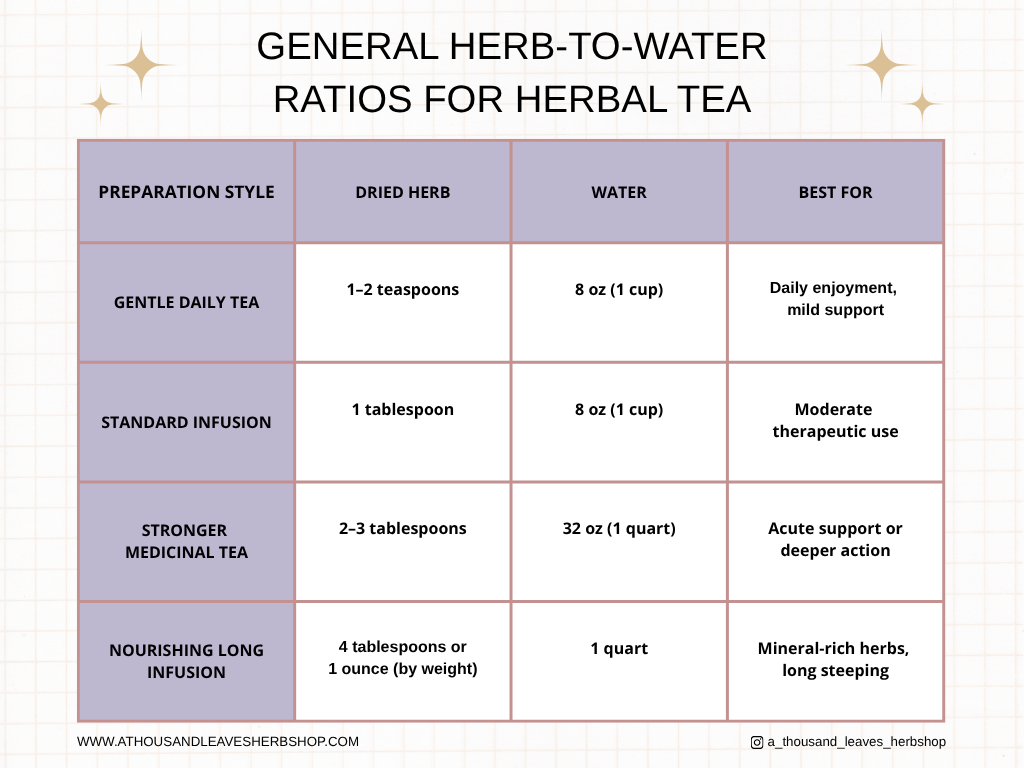
These measurements are general guidelines. The ideal ratio can vary depending on the herb, the plant part being used, and the desired strength of the tea.
If you are more of a visual learner check out our free video on Water Extractions:
If you are interested in diving further into Herbalism, consider our Beginner’s Herbal Program, where water extractions are just one of many herbal preparations you will learn more about!
Join Our Community
Herbal info, education, and shop updates right to your inbox